Tell me and I forget. Teach me and I remember. Involve me and I learn. Benjamin Franklin

Friday, November 28, 2014

WINTER 2015 HYBRID COURSE: Think-Tanks, International and Non-Governmental Organizations

Think-Tanks, International and Non-Governmental Organizations 
INTL 399 WINTER 2015
HYBRID COURSE
TUESDAY 14:00 - 15:50 PM
Connected Learning Course

READINGS:
International Organizations: Politics, Law, Practice By Ian Hurd. Cambrdige University Press, 2010.
NGOization Complicity, Contradictions and Prospects (Edited) By Aziz Choudry and Dip Kapoor. Zed Books, 2013.
Other readings will be posted on the D2L and you will find them under the course documents.


FOR MORE INFORMATION, PLEASE CONTACT
TUGRUL KESKIN INTERNATIONAL STUDIES
tugrulkeskin (at) pdx.edu

Course Description and Objective:
In this course, we will examine the emergence and development of think tanks and international and non-governmental organizations (NGOs) from a comparative perspective. In the 19th and 20th centuries, the concept of the modern state emerged out of the growth of capitalism and industrialization, and led to the creation of a complex bureaucracy and an interconnected social, political and economic environment within the global political arena.  However, WWI and II gave birth to the UN (originally the League of Nations) as a venue for negotiation between nation-states in the international arena in order to prevent political conflicts. Think tanks (semi-governmental institutions) are the other important economic and political actors within and between the modern nation-state. We will review the concept of the nation-state in this class. The emergence of think tanks or policy institutes dates back to the time of imperial Britain.
These institutions were affiliated with security studies at the beginning stages of their emergence because they support the colonial dream of imperialism; however, this has changed slightly with the establishment of American think tanks and the rise of the US as a global power. Hence, the Carnegie Endowment for International Peace (1910), the Brookings Institute (1916), the Hoover Institution (1919), The Century Foundation (1919), the Council on Foreign Relations (1921) and the Rand Corporation (1946) were all founded in the first half of the 20th century. They were, and still are affiliated with the security establishment of the US. However, these organizations started to play a more effective role within domestic politics in the second half of the 20th century, because of the rise of the neoliberal economy. Less Keynesianism in the modern American Economy led to an increase in the power and number of these policy-oriented institutions, and they expanded to the social and economic field within the US. As a result, the Heritage Foundation (1973) and Cato Institute (1974) were established. However, the power of think tanks did not become apparent until the first half of the 1980s. After the collapse of the Soviet Union, think tank politics began to dominate the American political landscape inside the beltway, taking on issues like drug policy to immigration, foreign policy and health care. This power led to considerable attention from American corporations. As a result of this trend, many more think tanks were established, and some changed their structures to collaborate with and meet the needs of corporations. Private funding has poured into these policy institutions ever since, and the term, ‘inside the beltway politics,’ coined in the 1980s and popularized in the 1990s, describes these circumstances. Today, the power and role of think tanks cannot be ignored, and should be studied academically from the standpoint of their origins, particularly their domestic and now international political usage. We will also study the emergence, development and role of non-governmental organizations such as the Committee to Protect Journalists, Doctors Without Borders, Mercy Corps, Amnesty International, and Human Rights Watch. All of these organizations are fairly new to the global social and political arena.          

Course Requirements

Item                                                                    Date                    Weight (%)
Weekly Reflection Papers or online quizzes   Sunday               48.0
Participation/Attendance                                                              5.0       
Online Discussion                                                                          12.0     
Weekly Presentations                                                                    10.0                 
Final Paper                                                         March 15th        25.0

Thursday, November 27, 2014

A Forecast Of When We’ll Run Out of Each Metal

Jeff Desjardins

Visual Capitalist - September 4, 2014 

Here is one interpretation of when we’ll run out of each metal or energy source. While the technicalities of some of this information can be debated, I think the general theme runs the same. There is a limited supply of these commodities – and if there are no discoveries, no price changes, and no changes in consumption, we are running out relatively soon. In my opinion, there are two caveats that are always worth considering when looking at something like this.
1. “Reserves” are an engineering number that are based on economic viability. Technically speaking, there are small concentrations of gold everywhere. It is just not usually viable to mine 0.1 g/t gold. When we will “run out” of each mineral in this chart is based on current reserves and prices. If the gold price doubles, then suddenly it is economic to mine more.
2. This chart is a reminder that something has to give. Either prices are going to have to go up, or new amazing discoveries have to be made to keep prices down. It’s basic economics, and either way it seems that there are many opportunities in the mining industry for investors and speculators on both fronts.

READ MORE....

Wednesday, November 26, 2014

A New Book: A Global Middle East: Mobility, Materiality and Culture in the Modern Age, 1880-1940

Edited by: Liat Kozma, Cyrus Schayech, Avner Wishnitzer

I.B. TAURIS - 2015

The start of the twentieth century ushered in a period of unprecedented change in the Middle East. These transformations, brought about by the emergence of the modern state system and an increasing interaction with a more globalized economy, irrevocably altered the political and social structures of the Middle East, even as the region itself left its mark on the processes of globalization themselves. As a result of these changes, there was an intensification in the movement of people, commodities and ideas across the globe: commercial activity, urban space, intellectual life, leisure culture, immigration patterns and education - nothing was left untouched. It shows how even as the Middle East was responding to increased economic interactions with the rest of the world by restructuring not only local economies, but also cultural, political and social institutions, the region's engagement with these trends altered the nature of globalization itself.This period has been seen as one in which the modern state system and its oftentimes artificial boundaries emerged in the Middle East. But this book highlights how, despite this, it was also one of tremendous interconnection. Approaching the first period of modern globalization by investigating the movement of people, objects and ideas into, around and out of the Middle East, the authors demonstrate how the Middle East in this period was not simply subject or reactive to the West, but rather an active participant in the transnational flows that transformed both the region and the world.A Global Middle East offers an examination of a variety of intellectual and more material exchanges, such as nascent feminist movements and Islamist ideologies as well as the movement of sex workers across the Mediterranean and Jewish migration into Palestine. A Global Middle East emphasises this by examining the multi-directional nature of movement across borders, as well as this movement's intensity, volume and speed. By focusing on the theme of mobility as the defining feature of 'modern globalization' in the Middle East, it provides an essential examination of the formative years of the region.

READ MORE....

Tuesday, November 25, 2014

Michael Brown, racism and America's open casket

Justice for African Americans will remain an illusion as long as America fails to account for racism.

Al-Jazeera - 25 Nov 2014 

Hatem Bazian 

Hatem Bazian is co-editor and founder of the Islamophobia Studies Journal and director of the Islamophobia Research and Documentation Project, and a senior lecturer in the Departments of Near Eastern and Ethnic Studies at Berkeley University.

"He was a black skin boy. So he was born to die," goes Bob Dylan's song, The Death of Emmett Till. The lyrics are as timely today as when they were first written and performed because "black skin" remains a threat and the cause of death of far too many in the United States and the world. The song relates the story of Emmett Till, a 14-year-old black youngster from Chicago, who was murdered while visiting relatives in Mississippi on August 28, 1955, by two white men because, supposedly, he flirted with a white woman.
Mamie, Emmett's mother, insisted on a public funeral in Chicago with an open casket for everyone to view the brutality of racism that completely disfigured and mutilated the face of her beautiful boy. The motionless body was Emmett's but the open casket is America's well-documented lynching history, racism, total otherisation and sub-humanness of African Americans.
America's soul continues to be burdened by the countless motionless African American bodies that pile up daily in inner city streets, alleyways and police shoot-outs. Not to leave behind the walking living bodies made motionless and numbed into a lifeless existence through racism: filling prisons, shattering dreams and creating permanent modern "civilised" slavery.

READ MORE.....

David Harvey’s Course on Marx’s Capital: Volumes 1 & 2

Open Culture | November 20th, 2014

Volumes 1

Volumes 2

Sunday, November 23, 2014

Varieties of Secularism in a Secular Age

Edited by Michael Warner Jonathan VanAntwerpen Craig Calhoun

Harvard University Press, 2010

“What does it mean to say that we live in a secular age?” This apparently simple question opens into the massive, provocative, and complex A Secular Age, where Charles Taylor positions secularism as a defining feature of the modern world, not the mere absence of religion, and casts light on the experience of transcendence that scientistic explanations of the world tend to neglect.
In Varieties of Secularism in a Secular Age, a prominent and varied group of scholars chart the conversations in which A Secular Age intervenes and address wider questions of secularism and secularity. The distinguished contributors include Robert Bellah, José Casanova, Nilüfer Göle, William E. Connolly, Wendy Brown, Simon During, Colin Jager, Jon Butler, Jonathan Sheehan, Akeel Bilgrami, John Milbank, and Saba Mahmood.

TABLE OF CONCTENTS:
  • Editors’ Introduction
  • 1. Confronting Modernity: Maruyama Masao, Jürgen Habermas, and Charles Taylor [Robert N. Bellah]
  • 2. A Closer Walk on the Wild Side [John Milbank]
  • 3. The Sacred, the Secular, and the Profane: Charles Taylor and Karl Marx [Wendy Brown]
  • 4. Completing Secularism: The Mundane in the Neoliberal Era [Simon During]
  • 5. Belief, Spirituality, and Time [William E. Connolly]
  • 6. What Is Enchantment? [Akeel Bilgrami]
  • 7. This Detail, This History: Charles Taylor’s Romanticism [Colin Jager]
  • 8. Disquieted History in A Secular Age [Jon Butler]
  • 9. When Was Disenchantment? History and the Secular Age [Jonathan Sheehan]
  • 10. The Civilizational, Spatial, and Sexual Powers of the Secular [Nilüfer Göle]
  • 11. A Secular Age: Dawn or Twilight? [José Casanova]
  • 12. Can Secularism Be Other-wise? [Saba Mahmood]
  • Afterword: Apologia pro Libro suo [Charles Taylor]
READ MORE.....

Global Wealth Report 2014

Credit Suisse - October 2014 

The credit suisse global Wealth Report provides the most comprehensive and up-to-date source of information on global household wealth. since 2010, we have collaborated with professors Anthonys Horrocks and Jim Davies, recognized authorities on this topic, and the principal authors of “ personal Wealth from a g lobal perspective,” Oxford University Press, 2008. unlike other studies, this report measures and analyzes trends in wealth across nations from the very base of the “wealth pyramid” to the ultra-high net worth individuals. the methodology is robust, established over many years of analysis, and completely transparent with regard to the underlying sources and their quality. Although the global economic environment has remained challenging, total global wealth has grown to a new record, rising by us D 20.1 trillion between mid-2013 and mid-2014, an increase of 8.3%, to reach us D 263 trillion – more than twice the us D 117 trillion recorded for the year 2000. With an 11.4% year-on-year increase, wealth creation was particularly strong in North America, where it now stands at us D 91 trillion, or 34.7% of total wealth. Europe made the second largest contribution, with wealth increasing 10.6% to us D 85.2 trillion. i n both regions, capital markets were a key source of wealth growth: equity market capitalization grew by 22.6% in the United States, while Canada, France and Germany all recorded gains close to 30%. a s we noted last year, Asia and particularly China will account for the largest portion of newly created wealth among the emerging markets. h owever, we find that emerging-market wealth growth has not been able to maintain its momentum from the pre-crisis period between 2000 and 2008. t his should not distract from the fact that personal wealth in i ndia and c hina has risen by a factor of 3.1 and 4.6 since 2000. While we have seen an uptrend in the share of wealth in emerging markets, that trend has come to a halt in recent years, mainly due to a de-acceleration in growth and underperforming equity markets. h owever, we expect to see a big improvement in the position of emerging economies over the next five years.

READ THE FULL REPORT......

Piketty’s prophecy comes true:

The planet’s middle class is rapidly going extinct New research reveals the superrich have grabbed half the world's resources -- and their wealth is only growing

Lynn Stuart Parramore

AlterNet -  Thursday, Oct 23, 2014 

According to a new report, the richest one percent have got their mitts on almost half the world’s assets. Think that’s the end of the story? Think again. This is only the beginning.
The “Global Annual Wealth Report,” freshly released by investment giant Credit Suisse, analyzes the shocking trend of growing wealth inequality around the world. What the researchers find is that global wealth has increased every year since 2008, and that personal wealth seems to be rising at the fastest rate ever recorded, much of it driven by strong equity markets. But the benefits of this growth have largely been channeled to those who are already affluent. While the restaurant workers in America struggled to achieve wages of $10 an hour for their labor, those invested in equities saw their wealth soar without lifting a finger. So it goes around the world.
The bottom half of the world’s people now own less than 1 percent of total wealth, and they’re struggling to hold onto even that minuscule portion. On the other hand, the wealthiest 10 percent have accumulated a staggering 87 percent of global assets. The top percentile has 48.2 percent of the world wealth. For now.

READ MORE....

Wednesday, November 19, 2014

Land for Death

Israel may face a wrenching choice between its democracy and Jewishness. And that’s normal.

By Lee Smith|

Tablet magazine - November 19, 2014

Maybe all of Europe will soon follow the Swedes in recognizing a Palestinian state. Last week the E.U.’s new foreign affairs chief Federica Mogherini expressed Europe’s general impatience and called for the prompt creation of a Palestinian state. The world, she said, “cannot afford” another war in Gaza. And to make good on her word, the E.U. is now threatening to sanction Israel if it continues to avoid taking the steps toward a two-state solution.
It’s worth noting that the E.U.’s threats to sanction Israel come on the eve of a likely nuclear deal with Iran that will relieve sanctions on the Islamic Republic. For Iran, sanctions relief will entail a virtual gold rush with European businesses investing billions in Tehran’s energy and auto sectors. In other words, the way Europe sees it, Israel’s partial military occupation of 2.2 million Palestinian inhabitants of the West Bank is far more dangerous to world peace than the rise of a nuclear-armed pariah state that wages terrorist operations on every continent in the world except Antarctica.

READ MORE.....

Tuesday, November 18, 2014

Frankfurt Open for Yuan Clearing as Liquidity Rises

By Weixin Zha

BLOOMBERG NEWS - Nov 17, 2014

Frankfurt, which is seeking to corner a share of the burgeoning offshore yuan market, has set the ball rolling with the first clearing of transactions in the Chinese currency.
Bank of China Ltd., chosen by the People’s Bank of China in June to clear payments in the euro-area’s financial capital, has spent the last five months building the infrastructure to facilitate settlements before the official start of clearing today. Deutsche Bank AG (DBK), Commerzbank AG (CBK), DZ Bank AG and Landesbank Hessen-Thueringen Girozentrale have cleared transactions through the Frankfurt hub, according to Bernd Meist, its managing director.

READ MORE.......

Monday, November 17, 2014

Tanzania’s Masai face homeland eviction…so Dubai royals can hunt

Russia Today - November 17, 2014

Masai people living in northern Tanzania are facing eviction from their historical homeland, as the government has reportedly reneged on a promise and is proceeding with plans to remake the land into a hunting reserve for Dubai's royal family.
There are about 40,000 Masai people living on the 1,500 square kilometer “wildlife corridor” bordering Serengeti National Park. They are known for their semi-nomadic ways and have their own distinctive culture.
The original proposal by a company based in the United Arab Emirates to turn the land into a commercial hunting park was turned down last year.
But the deal seems back on track now and the Masai people were notified to leave their ancestral lands by the end of the year, the Guardian reported.

READ MORE....

Friday, November 14, 2014

Wealth Inequality in America


US wealth inequality - top 0.1% worth as much as the bottom 90%

Not since the Great Depression has wealth inequality in the US been so acute, new in-depth study finds

Angela Monaghan

The Guardian - Thursday 13 November 2014

Wealth inequality in the US is at near record levels according to a new study by academics. Over the past three decades, the share of household wealth owned by the top 0.1% has increased from 7% to 22%. For the bottom 90% of families, a combination of rising debt, the collapse of the value of their assets during the financial crisis, and stagnant real wages have led to the erosion of wealth.
The research by Emmanuel Saez and Gabriel Zucman [pdf] illustrates the evolution of wealth inequality over the last century. The chart shows how the top 0.1% of families now own roughly the same share of wealth as the bottom 90%.
The picture actually improved in the aftermath of the 1930s Great Depression, with wealth inequality falling through to the late 1970s. It then started to rise again, with the share of total household wealth owned by the top 0.1% rising to 22% in 2012 from 7% in the late 1970s. The top 0.1% includes 160,000 families with total net assets of more than $20m (£13m) in 2012.
In contrast, the share of total US wealth owned by the bottom 90% of families fell from a peak of 36% in the mid-1980s, to 23% in 2012 - just one percentage point above the top 0.1%.

READ MORE....

The Human in University Education

by Paul A. Bové

LOS ANGELES REVIEW OF BOOKS - November 13th, 2014

LET ME BEGIN by explaining the aim of my title. I assume that two of the most important and closely tied purposes of a research university are the production and reproduction of knowledge, which goes hand in hand with the training of a new generation of scholars, researchers, and artists. We might say that these purposes rest on other more fundamental values, or we might say that they rest upon the claim that knowledge in and of itself is the highest value. Universities might serve truth aspirations, or social and political institutions, or aim to provide the practical wisdom needed to organize a sustainable civilization — or all.
Often, universities (and when I say universities, I mean research universities) seem to have only two objects of study: the natural world, and the human ­— with the latter often placed within the natural world. Chemistry studies carbon, for example, and enables invention, which remakes nature — think plastics or graphene. Psychiatry studies what its modern founder called the soul (psychē) — what contemporary practitioners call “mental behaviors.” Art historians study the technical details of visual objects and their creative processes, sometimes hoping to explain the nature of beauty, the place of art in human life processes, and/or the orders of culture. Of course, I could mention many other fields of study and research, some of which would intensify the divide between human and nature (e.g., quantum gravity) while others would close the gap (e.g., nanotechnology in medicine.) Things seem to have changed little since 1956, when C. P. Snow first made his general point about the existence of two cultures, one scientific and one humanistic. According to Snow, members of the science tribe could not speak to members of the literary tribe, and they did not share the same worldview. Snow’s claim was always overstated; and newer sciences that merge the human and the hard sciences — such as genetics and “digital humanities” — make it impossible to take what Snow said too literally.

READ MORE....

Thursday, November 13, 2014

How 1,000 years of Arabic scholarship advanced scientific debate – in pictures

BY Claire Shaw

THE GUARDIAN - Thursday 23 October 2014 

From the 9th to the 19th centuries, scholars and scribes used Arabic as a lingua franca to debate scientific ideas. Arabic-speaking scholars translated classical Greek, Persian and even Sanskrit texts on topics such as medicine, mathematics and astronomy. These scholars went far beyond translation and preservation and fostered a unique and vibrant scientific culture within the Arabic-speaking world. The British Library and Qatar Foundation have joined forces to launch a new bilingual online portal, the Qatar Digital Library, providing free access to 25,000 pages of fascinating medieval Arabic manuscript. Here’s a selection of some of the most influential scientific texts in history.

READ MORE AND SEE THE PICTURES.....

The End of NATO

by Victor Davis Hanson

Hoover Institute, Stanford University - Wednesday, November 12, 2014

Declaring the North Atlantic Treaty Organization dead has been a pastime of analysts since the end of the Cold War. The alliance, today 28-members strong, has survived 65 years because its glaring contradictions were often overlooked, given the dangers of an expansionist and nuclear Soviet Union and its Warsaw Pact subjects.
From its beginning, NATO had billed itself as a democratic Western bastion against Soviet totalitarian aggression—if not always in practice then at least in theory. NATO never had much problem keeping Greece and Turkey in the alliance despite their occasionally oppressive, rightwing military dictatorships, given the strategic location of both and the need to keep the pair’s historical rivalries in-house. If the alliance’s exalted motto “animus inconsulendo liber” (“A free mind in consultation”) was not always applicable, NATO still protected something far better than the alternative.
The United States opposed and humiliated its NATO partners France and Britain during the Suez crisis of 1956, without much damage to NATO at large. True, a petulant France after 1959, gradually withdrew its military participation—and yet secretly still pledged to fight with the alliance in the case of a Soviet attack. The 1989 unification of Germany progressed without a hitch, largely because an economically all-powerful Fourth Reich was happy to allow its historic rivals and NATO partners France and Britain to remain Europe’s only nuclear powers.

READ MORE....

Egyptian cartoonist Ahmed Toughan dies (1926-2014)


Ahmed Toughan, who began his career as a teenager in the early 1940s and was one of the young stars of the Rus Al-Yousef era (far predating the sham publication it later became). A man who lived a simple life, avoided the limelight, enjoyed his drink and cigarette all the way into his late 80s. Most importantly was his commitment to tackle imperialism in all its forms. His 50,000+ cartoons on British colonialism, decades of Israeli aggression, the Algerian revolution, petrocultures, third world predicaments (poverty, unemployment, authoritarianism, ignorance, illiteracy, sectarianism, radicalism etc), and the US invasion and occupation of Iraq are a hefty legacy to leave behind. While he may not have had the political acumen to foresee or anticipate how matters unfolded in the region, he nevertheless drew from his heart--which explains his equivocation and uncertainty over the years. Despite this, he knew who his adversaries were. His cartoons aside, he was a storyteller par excellence and laughed incessantly even in the most dire of times. He often described his life as one of an "itinerant vagabond."
Adel Iskandar

Published in Al-Gomhorriya on October 19, 1956. It represents a British soldier being told by his superior, "your father died defending the Trading Co. in India, and your uncle died in Malaya for the Rubber Co., so you are from a very reputable family that defended its country"!

Toughan loved the character of the "ghafeer" who he represented in different ways--both admirably and critically. He was part of the security apparatus of the state and he was the guardian of people's lives. Here is a utopian image of a ghafeer on guard in a rural village as everyone slept. (1948)

Ahmed Toughan 1996

Ahmed Toughan 1996

Ahmed Toughan 1996


Tuesday, November 11, 2014

China and US strike deal on carbon cuts in push for global climate pact

Barack Obama aims for reduction of a quarter or more by 2025, while Xi Jinping sets goal for emissions to fall after 2030

 Lenore Taylor, Guardian Australia political editor, Tania Branigan in Beijing and agencies

The Guardian - Wednesday 12 November 2014

The United States and China have unveiled a secretly negotiated deal to reduce their greenhouse gas output, with China agreeing to cap emissions for the first time and the US committing to deep reductions by 2025.
The pledges in an agreement struck between President Barack Obama and his Chinese counterpart, Xi Jingping, provide an important boost to international efforts to reach a global deal on reducing emissions beyond 2020 at a United Nations meeting in Paris next year.
China, the biggest emitter of greenhouse gases in the world, has agreed to cap its output by 2030 or earlier if possible. Previously China had only ever pledged to reduce the rapid rate of growth in its emissions. Now it has also promised to increase its use of energy from zero-emission sources to 20% by 2030.

READ MORE.....

American Bank Ownership


American Media Ownership


China's Singles' Day becomes world's most lucrative online shopping day

Russia Today - November 11, 2014

Singles’ Day, adapted by the Alibaba Group in 2009, has surpassed America's Black Friday to become the world's most lucrative online shopping day. With nearly $9 billion in sales, it is on track to becoming the most profitable manufactured holiday ever.
Singles' Day, a celebration for unmarried people in China, is a twist on the long-running tradition of Valentine’s Day. It was invented by students in the early 1990s. The date of Singles' Day, 11/11, is due to the association that single people have with the number one.
The holiday was adapted by the Alibaba Group in 2009. In just four years, sales have rocketed by 5,740 percent.
As of 10 p.m. local time in Hangzhou China, sales had already hit $8.6 billion – up from $5.75 billion in 2013.

READ MORE.....

Why Read New Books?

By Tim Parks

THE NEW YORK REVIEW OF BOOKS - November 11, 2014

Hasn’t it all been done before? Perhaps better than anyone today could ever do it? If so, why read contemporary novels, especially when so many of the classics are available at knockdown prices and for the most part absolutely free as e-books? I just downloaded for free the original Italian of Ippolito Nievo’s Confessions of an Italian. It’s beautifully written. I’m learning a lot about eighteenth- and nineteenth-century Italy. It’s 860 pages long. A few more finds like that and my reading time will all be accounted for. Why go search out the difficult contemporary author?
As a reviewer of books she would often pan, Virginia Woolf thought one of the pleasures of reading contemporary novels was that they forced you to exercise your judgement. There was no received opinion about a book. You had to decide for yourself whether it was good. The reflection immediately poses an intriguing semantic puzzle; if, on reading a book, you enjoy it, then presumably it is good, at least as far as you are concerned. This is not something you have to “decide.” If you have to decide whether a book is good, does that mean you don’t know whether you enjoyed it or not, an odd state of affairs, or you don’t know whether your enjoyment or lack of enjoyment is an appropriate response?

READ MORE.....

Slavery’s Shadow on Switzerland

By TONY WILD

The New York Times - NOV. 10, 2014

Two months ago, I discovered that my grandmother, Ida, had been a verdingkind, or “contract child,” in Switzerland in the 1890s.
A transcript from the archives in Teuffenthal, a small village south of Bern, the capital, confirmed that Ida, an orphan, had been contracted as an unpaid domestic servant to a woman in a neighboring village. The Swiss authorities used the nine-year-old’s meager inheritance to pay the woman 120 Swiss francs a year; Ida’s seven-year-old brother, Fritz, was made to pay 70 Swiss francs to fund his hardscrabble life as a farmhand. They both “had the appearance of being very hungry,” the document chillingly noted. They were kept under contract for about eight years.

READ MORE....

Monday, November 10, 2014

‘China to avoid dangerous maritime route thanks to gas deal with Russia’

Russia Today - November 10, 201

Most of China’s energy resources are imported via the Pacific, and is threatened by the US military presence. The gas deal with Russia allows China to minimize the risks, China-based journalist Brendan O'Reilly told RT.
Russia and China have agreed a second gas deal, the so-called western route. President Vladimir Putin and Chinese leader Xi Jinping signed a memorandum of understanding at the Asia-Pacific summit in Beijing. The deal is expected to be signed next year and secure a yearly supply of 30 billion cubic meters of gas to China.

READ MORE.....

Sunday, November 9, 2014

Privatization: Profiting At Public Expense

By Duncan Cameron

Popular Resistance - November 8th, 2014

In the 1980s governments began selling off public assets to private corporations. Government debt and deficits were the excuse. Citizen-owned wealth, held in trust by governments was transferred to profit-seeking companies. Public inheritance was turned into a one-time payment applied to the provincial or federal debt.
This practice was called privatization. It should have been called theft, since it amounted to stealing from the public what belonged to it.
The only way the practice of “selling the house to pay the mortgage” made any sense was if you were the one buying the house.
In 1994 the Saskatchewan government privatized its Potash Corporation for $630 million. In 2010 a hostile bid priced it at $38.6 billion. The bid was considered “insulting low.”
The bid revealed that because of the privatization of what belonged to them, citizens of Saskatchewan had been cheated out of more than a 63-fold increase in the value of the Potash Corporation!
As the world price of potash resources rocketed, PotashCorp profits had gone sky high. Money that could have been used to build hospitals, schools, and cultural and recreational facilities left the province, to the delight of the absentee landlord.
The government collected some taxes and charged royalties. But government revenues represented much less than the citizens of Saskatchewan were entitled to as owners of the natural resources.

READ MORE....

As western troops withdraw from Afghanistan, a small number of foreigners remain.

They talk about the war-torn country they have come to love

By Emma Graham-Harrison

The Guardian - Saturday 8 November 2014

Few people now move to Afghanistan to start a new life. Visitors once came for tourism or trade, but these days most arrive for work postings of a few months or a few years at most, to fight or deliver aid, take pictures, or flit from meetings in barricaded ministries to embassy cocktail parties. They do not expect to fall in love with a country that, in the west, more often makes headlines for its violence, extremism and corruption.
The past four decades of conflict have driven away millions of Afghans, and almost all the foreigners who had made a home here. But as British troops withdraw after a 13-year military occupation, and other Nato allies send their forces home, a small band of expats has stayed throughout the turmoil. Some have been seduced by the natural beauty of the country, the hospitality and extraordinary history – the stupas and temples, mosques and forts, decaying but still spectacular. Others kept coming back over the years, and eventually settled – staying for love, or for work – often seeing another side of Afghanistan. They may be worried about the future, in a land where the Taliban has stepped up its fight for both territory and Afghan support, infiltrating stretches of the countryside, where they control the roads, levy taxes, run schools and dispense justice. But they are not leaving the country they now call home.

READ MORE.....

Elizabeth Warren: It’s time to work on America’s agenda

By Elizabeth Warren

The Washington Post - November 7, 2014

Elizabeth Warren, a Democrat, represents Massachusetts in the Senate. 

There have been terrible, horrible, no good, very bad Election Days for Democrats before — and Republicans have had a few of those, too. Such days are always followed by plenty of pronouncements about what just changed and what’s going to be different going forward.  But for all the talk of change in Washington and in states where one party is taking over from another, one thing has not changed: The stock market and gross domestic product keep going up, while families are getting squeezed hard by an economy that isn’t working for them.  The solution to this isn’t a basket of quickly passed laws designed to prove Congress can do something — anything. The solution isn’t for the president to cut deals — any deals — just to show he can do business. The solution requires an honest recognition of the kind of changes needed if families are going to get a shot at building a secure future.

READ MORE....

No Women Need Apply

Chinese Women Fight to End Workplace Discrimination

LIJIA ZHANG

China File - 11.06.14

“Applicants limited to male.” 23-year-old job-hunter Huang Rong (not her real name) noticed this line in a job announcement only after she had heard nothing from the recruiter and gone back to check the advertisement online. She had graduated from Xinyang Normal University in Henan province with a degree in social work this summer, and she said the job sounded perfect for someone who enjoyed talking to people: a clerk position, combining executive assistants’ responsibilities with more creative tasks such as coming up with marketing campaign ideas for the well-established New Oriental Cooking School, a company based in her favorite city, Hangzhou.  “I didn’t understand why a clerk’s position would be open only to men,” Huang said in a telephone interview from Hangzhou. So she called the school and was told that the job required travel and some physically demanding tasks such as carrying the school director’s suitcases. Huang made it clear that she didn’t mind traveling and she was physically quite strong, but her application was rejected nonetheless. She went to the school to appeal in person but to no avail.

READ MORE....

How to Write an Article in No Time


The Free Market Did Not Bring Down the Berlin Wall

The United States has misinterpreted the end of Communism for a quarter of a century. It's time to set the record straight.     

BY Melvyn P. Leffler    

Foreign Policy - NOVEMBER 7, 2014

On Nov. 9, 1989, Gunter Schabowski, an East German regime spokesperson, fumbled through a press conference and changed history.
Although Schabowski was a member of the Politburo, he had not attended its meeting earlier in the day when the committee decided on the Communist Party's new travel regulations. He hadn't even read them over when he stood before the room full of reporters.
For months, East Germans had been fleeing to West Germany, either through Hungary or Czechoslovakia. The regime was deeply embarrassed, and it was shaken even more by the growing turmoil in its cities. Demonstrators had been gathering peacefully in Leipzig, week after week for several months, attracting ever-larger crowds. Spurred by church groups, environmentalists, and non-governmental organizations seeking peace and disarmament, East Germans marched in the streets, clamoring for change but also fearing repression.
In her new book The Collapse, historian Mary Sarotte details the roles of ordinary individuals and the accidents that led to the fall of the Berlin Wall: Party leaders knew they had to draft new travel rules to defuse the crisis at home and deflect growing pressure from their comrades in Prague, Budapest, and Moscow. But they did not want to throw open the borders. They did not intend to allow East Germans to leave without seeking permission.

READ MORE....

Wednesday, November 5, 2014

The World, Mapped by Phone

Calls Who you gonna call? Relatives in Mexico.

Kathy Gilsinan

The Atlantic - Nov 4 2014

What does global communication look like? One way to picture it is by mapping phone calls—specifically where they're coming from and heading to. The map below, first flagged by my colleague Tim Fernholz at Quartz, shows a year's worth of cross-border calls, as measured in minutes per person spent on international phone calls in 2012, the most recent year for which data is available. It's one component of a study, written by business scholars Pankaj Ghemawat and Steven A. Altman, with funding from the logistics firm DHL, that aims to quantify globalization by tallying up measures of "cross-border flows of trade, capital, information, and people."


READ MORE.....

Gates Foundation focuses $3bn agro-fund on rich countries, ‘pushes GMO agenda in Africa’

Russia Today - November 05, 2014

The Bill & Melinda Gates Foundation gives the majority of its $3 billion in food and agricultural grants to rich Western countries, with critics accusing it of using its money to force a pro-GMO agenda on Africa, a recent report suggests.
GRAIN, a small international non-profit, made its accusation after breaking down the foundation’s distribution of grants handed out between 2013 and 2014.
Roughly $1.5 billion ends up in the hands of hundreds of different research, development and policy organizations, 80 percent of which are based in the US and Europe. Only 10 percent of those groups, meanwhile, are in Africa.

READ MORE.....

Tuesday, November 4, 2014

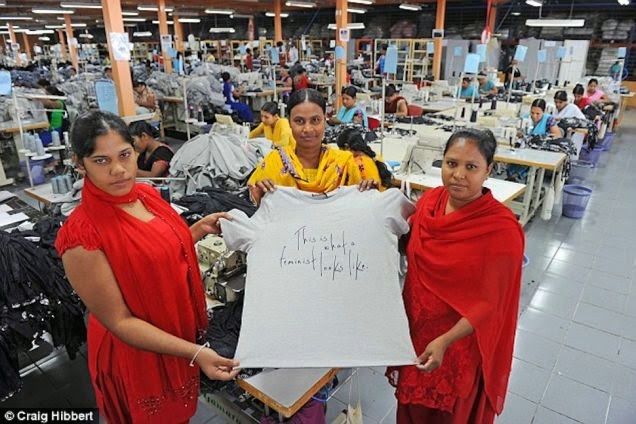
Women Making $70 Feminist Shirts in Factory Paid Under a Dollar an Hour

Dayna Evans

Gawker - November 3, 2014

In a new investigative report published at the Mail on Sunday, a reporter discovered that women in Mauritius who were hired to make shirts that read "This is what a feminist looks like" have been paid roughly a dollar an hour to do so and sleep in dormitories that house 16 women at a time.
The shirts, which are sold in conjunction with Fawcett Society (whose slogan is "Working for women's rights since 1886") and have been worn by everyone from Simon Pegg to Nick Clegg to British politician Harriet Harman, are made by migrant women who make a quarter of the average monthly salary in Mauritius.

READ MORE....

A Conversation With Henry A. Kissinger

Speaker: Henry A. Kissinger, Chairman, Kissinger Associates, Inc.; Former U.S. Secretary of State; Former Assistant to the President for National Affairs
Presider: Richard N. Haass, President, Council on Foreign Relations
November 4, 2014


The American Middle Class Is No Longer the World’s Richest

By David Leonhardt and Kevin Quealy 

The New York Times - APRIL 22, 2014 

The American middle class, long the most affluent in the world, has lost that distinction.
While the wealthiest Americans are outpacing many of their global peers, a New York Times analysis shows that across the lower- and middle-income tiers, citizens of other advanced countries have received considerably larger raises over the last three decades.
After-tax middle-class incomes in Canada — substantially behind in 2000 — now appear to be higher than in the United States. The poor in much of Europe earn more than poor Americans.
The numbers, based on surveys conducted over the past 35 years, offer some of the most detailed publicly available comparisons for different income groups in different countries over time. They suggest that most American families are paying a steep price for high and rising income inequality.

READ MORE....

Sunday, November 2, 2014

History of the 1979 Iranian revolution and Imam Khomeini (I) - Press TV's Documentary

History of the 1979 Iranian revolution

Imam Khomeini (I) - Press TV's Documentary

World Development Indicators: Women in development

World Development Indicators: Women in development

Women in National Parliaments
Inter Parliamentary Union - October 1, 2014
The data in the table below has been compiled by the Inter-Parliamentary Union on the basis of information provided by National Parliaments by 1st October 2014. 189 countries are classified by descending order of the percentage of women in the lower or single House. Comparative data on the world and regional averages as well as data concerning the two regional parliamentary assemblies elected by direct suffrage can be found on separate pages. You can use the PARLINE database to view detailed results of parliamentary elections by country.
SEE THE CHART.....

REPORT: Women in National Parliaments (2013) - Inter Parliamentary Union

Saturday, November 1, 2014

Internet Entrepreneurs Top New Forbes Ranking Of China's Richest

This story appears in the November 3, 2014 issue of Forbes Asia.

The quicksilver of the Chinese Internet may even exceed what the Web bestows elsewhere. Especially when an outfit from China enjoys a U.S. stock listing. Look no further than Liu Qiangdong and his Amazon-like online shopping site JD.com. Though it lost money in the first half, it rocketed on the share market after a May IPO. Even with a 22% comedown from its peak, JD.com’s $35 billion valuation is sufficient to lift Liu from 98th on last year’s China Rich List to 10th this time, with $7.1 billion.

Click here for the full list of China’s Richest

JD.com, like many independent e-commerce sites in China, will continue to face volatile prospects, not just because of the changing fortunes of Chinese consumers but also because of how the Web itself continues to consolidate. Pushing that latter shift are the three dominant figures on the 2014 list, the founders of Alibaba, Baidu and Tencent. Effectively megaportals, the three companies are swallowing up Internet players and functions, looking abroad and in the process proving reliably profitable.

READ MORE.....

For The First Time, India's 100 Richest Of 2014 Are All Billionaires

This story appears in the October 20, 2014 issue of Forbes Asia.

After the Bharatiya Janata Party’s landslide victory in May’s federal election, Prime Minister Narendra Modi famously tweeted that “good days are here.” Indeed, they’re back with a bang for India’s 100 Richest. For the first time the top 100 are all billionaires, with combined wealth of $346 billion, up more than a third from 11 months ago. Propelled by the euphoria, the stock market has gained 28% since January, though the economy, growing at 5.7% in the last quarter, has yet to catch up. Food inflation, hardly the concern of the wealthy, still hovers at close to double digits.

Click here for the full list of India’s Richest

Snatching the biggest bonanza is ports magnate Gautam Adani, who hails from Modi’s native Gujarat state and is known to be the PM’s personal friend. Shares of Adani’s companies started soaring ahead of the elections on hopes of a BJP victory. The gains added close to $4.5 billion to his wealth, more than anyone else. Adani, who jumped 11 spots to No. 11, has since been on a buying spree: He bought a port in eastern India from the Tata Group for $900 million and agreed to pay $1 billion for a power plant in southern India.

READ MORE....

The Richest People On The Planet 2014

By Kerry A. Dolan and Luisa Kroll

Forbes -  3/03/2014
 
The ranks of the world’s billionaires continue to scale new heights–and stretch to new corners of the world. Our global wealth team found a record 1,645 billionaires with an aggregate net worth of $6.4 trillion, also a record, up from $5.4 trillion a year ago. We unearthed 268 new ten-figure fortunes, including 42 new women billionaires, both also records. In total, there are 172 women on the list, more than ever before and up from 138 last year.
Bill Gates is back on top after a four-year hiatus, reclaiming the title of world’s richest person from telecom mogul Carlos Slim Helu of Mexico, who ranked No. 1 for the past four years. Gates, whose fortune rose by $9 billion in the past year, has held the top spot for 15 of the past 20 years. Spanish clothing retailer Amancio Ortega (best known for the Zara fashion chain) retains the No. 3 spot for the second year in a row, extending his lead over Warren Buffett, who is again No. 4. American gambling tycoon Sheldon Adelson, who added $11.5 billion to his pile, makes it back into the top ten for the first time since 2007.

READ MORE....

Bourdain: Iran different from what I could have imagined

Fareed speaks with author and chef Anthony Bourdain about his visit to Iran.

Watch the full interview on GPS this Sunday at 10 a.m. and 1 p.m. ET on CNN, or watch Bourdain in Iran

So you did the thing most American negotiators haven't yet done, which is actually go to Iran.
Yes, and an incredible experience. What we saw inside Iran was extraordinary, heartbreaking, confusing, inspiring and very, very different than the Iran I expected from looking at it from afar, from a geopolitical sense or what we read on the news – what we know from that long and very contentious relationship we've had as nations.
What do you think was the most surprising thing to you?
To walk down the street as an American and have total strangers constantly saying, where are you from? America, have you tried our food? Thank you for coming. Just outgoing, friendly, welcoming to strangers, to a degree that we really experience very, very few places – and I'm talking Western Europe and allied nations.
We'd been told to expect that. But you get thrown by it when you face it everywhere. Our producer – it was his birthday and we all went out with our local crew to a very crowded restaurant. Traditional Persian music and Iranian families eating. And someone found out that my producer, it was his birthday. The entire restaurant sang "Happy Birthday" to him and presented him with a cake. It was a very different Iran than I had been led to expect or could have imagined.

READ MORE.....

The Berlin Wall fell 25 years ago, but Germany is still divided

By Rick Noack

The Washington Post - October 31, 2014

It can be hard for visitors to Berlin to imagine where the Berlin Wall once separated Germany's communist East from the U.S.-friendly West. Today, commuters run to catch a metro where trains stood for nearly 40 years. Curried sausages are sold and illegal (but popular) parties are celebrated in empty warehouses just feet from where East Germans were shot by their own countrymen as they tried to cross the border to the west.  Next week, Germany will celebrate the 25th anniversary of the fall of the Berlin Wall and at first glance, it seems as if the country is more united than some nations that were never split.  But numbers and images illustrating differences in lifestyles and problems between East and West Germans tell a different story. While 75 percent of Germans who live in the east said they considered their country's reunification a success in a recent survey only half of western Germans agreed. And that's not the only distinction indicating that the separation of the past prevails today.

READ MORE.....

Friday, October 31, 2014

Documentary: Gaddafi The Truth About Libya


Ten Things You Didn't Know About Libya Under Gaddafi's So-called Dictatorship

Urban Times - 16th May 2014

What do you think of when you hear the name Colonel Gaddafi? Tyrant? Dictator? Terrorist? Well, a national citizen of Libya may disagree but we want you to decide.

Ruling the country for for 41 years until his demise in October 2011, Muammar Gaddafi did some truly amazing things for his country and repeatedly tried to unite and empower the whole of Africa. So despite what you’ve heard on the radio, seen in the media or on the TV Gaddafi did some powerful things that were not very reminiscent of a vicious dictator. Here are ten things Gaddafi did for Libya that you may not know about…

1. In Libya a home is considered a natural human right
2. Education and medical treatment were all free
3. Gaddafi carried out the worlds largest irrigation project
4. It was free to start a farming business.
5. A bursary was given to mothers with newborn babies.
6. Electricity was free.
7.  Cheap petrol
8. Gaddafi raised the level of education
9. Libya had It’s own state bank
10. The gold dinar

READ MORE....

The Uyghurs


China's obsession with vertical cities

By the end of next year one-in-three of the world’s 100m+ skyscrapers will be in China, as its state-orchestrated urbanisation drive prompts a megacity building bonanza

Nicola Davison in Shanghai 

The Guardian - Thursday 30 October 2014

In late September, the Council on Tall Buildings and Urban Habitat, a non-profit organisation that keeps the world’s largest database on skyscrapers, held its annual conference in Shanghai – two years after its last meeting there. “We’ve never done that before, gone back to the same city,” says Antony Wood, the council’s executive director. “But right now, most of the major advances in the typology, in design or in technical terms, are happening in China.”
As the global population rises and cities become more crowded, the fabric of urban centres is changing. Nowhere is the phenomenon more pronounced than in China, where a state-orchestrated urbanisation drive has prompted a megacity building bonanza characterised by skyscrapers and sprawl. By the end of 2015, one in three of the world’s buildings over 150-metres will be in China. Construction of the world’s second-tallest building, the 632-metre tall Shanghai Tower, is due to be completed next year.
Few people outside China have heard of Suzhou, a city in the eastern province of Jiangsu with a population of 1.3 million (China now has over 140 cities of more than one million people; America has nine). Yet if all goes to plan, Suzhou will soon boast the world’s third-tallest building, the 700m Zhongnan Centre. Other Chinese cities joining the upward rush include Shenzhen, Wuhan, Tianjin and Shenyang. By 2020, China is set to be home to six of the world’s 10 tallest buildings, although none will top the globe’s current highest, the 828m Burj Khalifa in Dubai.

READ MORE....

Thursday, October 30, 2014

An Interview: Michael Burawoy on Global Social Movements

By Matt Gunther

Office Hours - 10/24/2014

Famed sociologist Michael Burawoy visits to share his thoughts on the common character of social movements happening throughout the world today. Michael is the former president of both the American and International Sociological Associations, and he is widely credited as a master of placing everyday life in the context of global and historical forces. Our own Erik Kojola asks Michael about his vision for the future of social movement research, as well as the mounting problems that face public universities today.

LISTEN THE INTERVIEW.....

Tuesday, October 28, 2014

Fiji PM Criticized For Saying Development Should Primarily Benefit Supporters

Opposition MPs call on Bainimarama to treat everyone equally

By Siteri Sauvakacolo

Pacific Islands Report - Oct. 28, 2014

SUVA, Fiji (Fiji Times, Oct. 28, 2014) – Itaukei Affairs Shadow Minister and member of the Opposition, Ratu Naiqama Lalabalavu, said development funds for Fijians come from all taxpayers as well as foreign donors and they have equal rights for their tax dollars to be used for their wellbeing.
He made the statement in response to comments made by Prime Minister Rear Admiral (Ret) Voreqe Bainimarama that he was a bit worried about continuing with development projects in the Northern Division because some voters didn't vote for the FijiFirst party in the recent general election.
While addressing government officials and some villagers at Naulumatua House in Nabouwalu, Bua, on Saturday, Rear Admiral (Ret) Bainimarama said people in some parts of the Northern Division didn't want developments to take place in their respective settings, prompting them to vote for SODELPA.
Ratu Naiqama, in a statement yesterday, called on foreign aid donors to take heed of the stated position of the Prime Minister and be sure to secure guarantees that the funds they give to Fiji for the benefit of all people are not used primarily to benefit only FijiFirst supporters.
The Cakaudrove chief said foreign countries would do well to tread cautiously when re-establishing relations with the Government.
READ MORE.....

Living Wages, Rarity for U.S. Fast-Food Workers, Served Up in Denmark

By LIZ ALDERMAN and STEVEN GREENHOUSE

The New York Times - OCT. 27, 2014

COPENHAGEN — On a recent afternoon, Hampus Elofsson ended his 40-hour workweek at a Burger King and prepared for a movie and beer with friends. He had paid his rent and all his bills, stashed away some savings, yet still had money for nights out.
That is because he earns the equivalent of $20 an hour — the base wage for fast-food workers throughout Denmark and two and a half times what many fast-food workers earn in the United States.
“You can make a decent living here working in fast food,” said Mr. Elofsson, 24. “You don’t have to struggle to get by.”
With an eye to workers like Mr. Elofsson, some American labor activists and liberal scholars are posing a provocative question: If Danish chains can pay $20 an hour, why can’t those in the United States pay the $15 an hour that many fast-food workers have been clamoring for?

READ MORE....

Sunday, October 26, 2014

World Air traffic in 24 and A Day in the Life of Air Traffic Over the United States

World Air traffic in 24

A Day in the Life of Air Traffic Over the United States

European Roma descended from Indian 'untouchables', genetic study shows

Roma gypsies in Britain and Europe are descended from "dalits" or low caste "untouchables" who migrated from the Indian sub-continent 1,400 years ago, a genetic study has suggested.

By Dean Nelson New Delhi

The Telegraph - 03 Dec 2012

Gypsies have long believed they have origins in India, citing common Sanskrit words in their languages and photographs of darker-skinned ancestors in South Asian clothes, while earlier research has offered some scientific support for their suspicions.
Now a study led by Indian and Estonian academics, including Dr Toomas Kivisild of Cambridge University, has confirmed their origins in the Indian sub-continent, and even identified the location and social background from which they emerged.
The findings have been welcomed by Britain's Gypsy Council, which said it would help to promote understanding of Roma people throughout Europe. "We are Britain's first Non-Resident Indian community," said council spokesman Joseph Jones.
The study, which was published this month in the journal Nature, examined Y chromosomes in DNA samples to compare the genetic signatures of European Roma men with those of thousands of Indians from throughout the sub-continent.

READ MORE....

Dilma Rousseff is reelected president of Brazil in bitterly fought runoff

By Dom Phillips

The Washington Post - October 26, 2014

Brazilian President Dilma Rousseff was reelected by a whisker in a second-round head-to-head vote, after one of the closest, most aggressive campaigns in the country’s recent history.
Rousseff, whose left-wing Workers’ Party has governed Brazil since 2003, had 51.6 percent with 99 percent of votes counted. Aécio Neves, the center-right candidate for the Brazilian Social Democratic Party, came second, with 48.4 percent.
Cheers rang out and firecrackers exploded in central Rio as the results came in. The election was the top subject of discussion Sunday, with Workers’ Party activists carrying red flags and both sides setting up camps under awnings on city streets.
Rousseff’s party campaigned hard on its social policies, playing down Brazil’s stumbling economy and emphasizing social programs, which have helped to reduce poverty by 55 percent since 2003.

READ MORE....

Saturday, October 25, 2014

Intermarriage: Can Anything Be Done?

The battle is over; or so we’re told. A half-century after the rate of intermarriage in the US began to skyrocket, the Jewish community appears to have resigned itself to the inevitable. But to declare defeat is preposterous.

Jack Wertheimer

Mosaic Magazine - Sept. 3 2013

The battle is over; or so we’re told. A half-century after the rate of Jewish intermarriage began its rapid ascent in the United States, reaching just under 50 percent by the late 1990s, many communal spokesmen appear to have resigned themselves to the inevitable. Some speak in tones of sorrow and defeat. Encouraging endogamy, they say, has become a fool’s errand; few Jews are receptive to the message, and short of a wholesale retreat into the ghetto, no prophylactic measure will prevent them from marrying non-Jews. For others, the battle is over because it should be over. Not only, they say, are high rates of intermarriage inevitable in an open society, but they constitute glorious proof of just how fully Jews have been accepted in today’s America. The real threat, according to this view, emanates from those who stigmatize intermarried families as somehow deficient; with a less judgmental and more hospitable attitude on the part of communal institutions, many more intermarried families would be casting their lot with the Jewish people.

READ MORE....

China may find its match in PM Narendra Modi

The Times of India - October 8, 2014

Indrajeet Rai

The timing of the recent 16-day stand-off between the Chinese and the Indian forces in the Ladakh sector was very odd. It started just a few days before Chinese President Xi Jinping’s maiden visit to India. It outlasted Xi’s India trip. In a quirky situation, both – the Chinese President and the PLA troops — were inside the Indian territory.  Various explanations have been offered for the peculiar timing of this stand-off between PLA troops and the Indian Army. The first and foremost is that Chinese President Xi Jinping wanted to put pressure on the Narendra Modi government before embarking on his India tour. Second, China does not like the growing bonhomie between India and Japan and the incursions were the Chinese way of saying that China can put India under mat at any time of its choosing. Third, these intrusions were meant to signal that growing bilateral trade between the two countries has not made China lenient in any way. When it comes to the settlement of the border row, China would be as tough as ever. Finally, India under PM Narendra Modi has become more aggressive at the LAC and, unlike in the past, the Indian Army refused to budge and held its ground.

READ MORE....

Why women leave academia and why universities should be worried

The Guardian - Thursday 24 May 2012

A recent report reveals that only 12% of third year female PhD students want a career in academia. Curt Rice looks at the reasons why and warns that universities' survival is at risk

Young women scientists leave academia in far greater numbers than men for three reasons. During their time as PhD candidates, large numbers of women conclude that (i) the characteristics of academic careers are unappealing, (ii) the impediments they will encounter are disproportionate, and (iii) the sacrifices they will have to make are great.
This is the conclusion of The chemistry PhD: the impact on women's retention, a report for the UK Resource Centre for Women in SET and the Royal Society of Chemistry. In this report, the results of a longitudinal study with PhD students in chemistry in the UK are presented.
Men and women show radically different developments regarding their intended future careers. At the beginning of their studies, 72% of women express an intention to pursue careers as researchers, either in industry or academia. Among men, 61% express the same intention.
By the third year, the proportion of men planning careers in research had dropped from 61% to 59%. But for the women, the number had plummeted from 72% in the first year to 37% as they finish their studies.

READ MORE....

Friday, October 24, 2014

Three major nations absent as China launches World Bank rival in Asia

Reuters | Oct 24, 2014

SHANGHAI: Australia, Indonesia and South Korea skipped the launch of a China-backed Asian infrastructure bank on Friday as the United States said it had concerns about the new rival to Western-dominated multilateral lenders.
China's $50 billion Asian Infrastructure Investment Bank (AIIB) is seen as a challenge to the World Bank and Asian Development Bank, both multilateral lenders that count Washington and its allies as their biggest financial backers.
China, which is keen to extend its influence in the region, has limited voting power over these existing banks despite being the world's second-largest economy.  

The AIIB, launched in Beijing at a ceremony attended by Chinese finance minister Lou Jiwei and delegates from 21 countries including India, Thailand and Malaysia, aims to give project loans to developing nations. China is set to be its largest shareholder with a stake of up to 50 percent.
Indonesia was not present and neither were South Korea and Australia, according to a pool report.


READ MORE....

The trap of materialism