Tell me and I forget. Teach me and I remember. Involve me and I learn. Benjamin Franklin

Monday, July 2, 2018

An Alternative Economics Summer Reading List - Carolina Alves

Developing Economics - July 1, 2018 

This is a response list to Martin Wolf’s FT column recommending Economics books of 2018 for summer reading. While there are many good books listed, we were struck by the consistent monism in his choices, as the books are all by scholars based in either the UK or the US, 12/13 of the authors are men and most of them come from the same theoretical tradition. Such lists perpetuate the strong white male – and mainstream – biases in our field (the recent list by The Economist suffers from the same biases).
To counter these biases, and with the purpose of broadening our field to become more inclusive of diverse approaches and perspectives, we have put together an alternative list. We deliberately chose books by scholars approaching Economics with alternative theoretical frameworks and by scholars from groups that tend to be excluded from the field, namely women, people of color, and scholars from the Global South. We recognize that no one is exempt from biases, which is why we are providing an explanation for the motivation behind our selection. Due to institutional and language barriers we were unable to include as many scholars from the Global South as we would have liked. For example, we would love to read the new book Valsa Brasileira by Laura Carvalho, but we are still waiting for the English translation. We hope you enjoy it and welcome more suggestions in the comments section.
Teaching the History of Economic Thought – Integrating Historical Perspectives into Modern Economics
By Daniela Tavasci and Luigi Ventimiglia | 2018, Edward Elgar Publishing
Stemming from the idea that economics is a social science that tends to forget its own history, this refreshing book reflects on the role of teaching with historical perspectives. It offers novel ways of integrating the history of economics into the curriculum, both in history of economic thought modules and in other sub-disciplines. Coming from a wide diversity of experiences, the chapters share the idea that studying the history of thought exposes students to pluralism and is therefore an essential pedagogical tool.
See more here.

Building Power from Below: Chilean Workers Take On Walmart

By Carolina Bank Munoz | 2018, Combined Academic Publishers
This book attributes Chilean workers’ success in challenging the world’s largest corporation to their organizations’ commitment to union democracy and building strategic capacity. Chilean workers have spent years building grassroots organizations committed to principles of union democracy. Retail workers’ unions have less structural power, but have significant associational and symbolic power. Their most notable successes have been in fighting for respect and dignity on the job. Warehouse workers by contrast have substantial structural power and have achieved significant economic gains. While the model in Chile cannot necessarily be reproduced in different countries, we can gain insights from the Chilean workers’ approaches, tactics, and strategies.
See more here.

When Things Don’t Fall Apart – Global Financial Governance and Developmental Finance in an Age of Productive Incoherence

By Ilene Grabel | 2018, MIT Press
Ilene Grabel challenges the dominant view that the global financial crisis had little effect on global financial governance and developmental finance. Most observers discount all but grand, systemic ruptures in institutions and policy. Grabel argues instead that the global crisis induced inconsistent and ad hoc discontinuities in global financial governance and developmental finance that are now having profound effects on emerging market and developing economies. Grabel’s chief normative claim is that the resulting incoherence in global financial governance is productive rather than debilitating. Inspired by Albert Hirschman, Grabel demonstrates that meaningful change often emerges from disconnected, erratic, experimental, and inconsistent adjustments in institutions and policies as actors pragmatically manage in an evolving world.
See more  here.

International Trade Policy and Class Dynamics in South Africa. The Economic Partnership Agreement

By Simone Claar | 2018, Palgrave Macmillan
This book provides an innovative perspective on class dynamics in South Africa, focusing specifically on how different interests have shaped economic and trade policy. As an emerging market, South African political and economic actions are subject to the attention of international trade policy.. Claar provides an in-depth class analysis of the contradictory negotiation processes that occurred between South Africa and the European Union on Economic-Partnership Agreements (EPA), examining the divergent roles played by the political and economic elite, and the working class. The author considers their relationships with the new global trade agenda, as well as their differing standpoints on the EPA.
See more here.

Modern Imperialism, Monopoly Finance Capital, and Marx’s Law of Value

By Samir Amin | 2018, Monthly Review Press
Samir Amin extends Marx’s analysis to describe a concept of “imperialist rent” derived from the radically unequal wages paid for the same labor done by people in both the Global North and the Global South, the rich nations and the poor ones. This is global oligopolistic capitalism, in which finance capital has come to dominate worldwide production and distribution. Amin also advances Baran and Sweezy’s notion of economic surplus to explain a globally monopolized system in which Marx’s “law of value” takes the form of a “law of globalized value,” generating a super-exploitation of workers in the Global South. This book offers readers a complete collection of Amin’s work on Marxian value theory and includes Amin’s answers to his critics.
See more here.

Work: The Last 1,000 Years

By Andrea Komlosy | 2018, Verso
By the end of the nineteenth century, the general Western conception of work had been reduced to simply gainful employment. But this limited perspective contrasted sharply with the personal experience of most people in the world—whether in colonies, developing countries or in the industrializing world. Moreover, from a feminist perspective, reducing work and the production of value to remunerated employment has never been convincing. Andrea Komlosy argues in this important intervention that, when we examine it closely, work changes its meanings according to different historical and regional contexts. Globalizing labour history from the thirteenth to the twenty-first centuries, she sheds light on the complex coexistence of multiple forms of labour on the local and the world levels.
See more here.

Extracting Profit – Imperialism, Neoliberalism and the New Scramble for Africa

By Lee Wengraf  | 2018, Haymarket Books
Extracting Profit argues that the roots of today’s social and economic conditions lie in the historical legacies of colonialism and the imposition of so-called “reforms” by global financial institutions such as the World Bank and International Monetary Fund. And while the scramble for Africa’s resources has heightened the pace of ecological devastation, examples from Somalia and the West African Ebola outbreak reveal a frightening surge of militarization on the part of China and the U.S. Yet this “new scramble” has not gone unchallenged. Extracting Profit offers several narratives of grassroots organizing and protest, pointing to the potential for resistance to global capital and fundamental change, in Africa and beyond.
See more here

Algorithms of Oppression – How Search Engines Reinforce Racism

By Safiya Umoja Noble | 2018, NYU Press.
Safiya Umoja Noble challenges the idea that search engines like Google offer an equal playing field for all forms of ideas, identities, and activities. Data discrimination is a real social problem; Noble argues that the combination of private interests in promoting certain sites, along with the monopoly status of a relatively small number of Internet search engines, leads to a biased set of search algorithms that privilege whiteness and discriminate against people of color, specifically women of color. Through an analysis of textual and media searches as well as extensive research on paid online advertising, Noble exposes a culture of racism and sexism in the way discoverability is created online.
See more here

Economics of Real-Life – A New Exposition

By C.T. Kurien | 2018,  Academic Foundation
Economics of Real-Life: A New Exposition is possibly the first book attempting to introduce interested readers to the working of contemporary economies with special reference to India. Unlike most introductory books in economics its objective is not to concentrate on a priori logic based on untested (and untestable) premises, but to rely on the history of the evolution of human communities from the rudimentary state to the latest because economic activities—social interaction to provide the material basis for survival and to go beyond—is common to all. The book relies on ‘capsule history’ and ‘thought experiments’ as expository devises.
See more here.

Turbulence and Order in Economic Development: Institutions and Economic Transformation in Tanzania and Vietnam

By Hazel Gray | 2018, Oxford University Press
The terms of debate on the role of institutions in economic development are changing. Stable market institutions, in particular, secure private property rights and democratically accountable governments that uphold the rule of law, are widely seen to be a pre-requisite for economic transformation in low income countries, yet over the last thirty years, economic growth and structural transformation has surged forward in a range of countries where market and state institutions have differed these ideals, as well as from each other. Gray studies the role of the state in two such countries, examining the interplay between market liberalization, institutions, and the distribution of power in Tanzania and Vietnam.
See more here.

Classical Economics Today – Essays in Honor of Alessandro Roncaglia

By Marcella Corsi, Jan Kregel, and Carlo D’Ippoliti | 2018, Anthem Press
This book is a collection of essays that investigates and applies the method and principles of Classical political economy to current issues of economic theory and policy. The contributors to the volume, like all classical economists in general, regard history as a useful tool of analysis rather than a specialist object of investigation. By denying that a single, all-encompassing mathematical model can explain everything we are interested in, Classical political economy necessarily requires a comparison and integration of several pieces of theory as the only way to discuss economics and economic policy. Economists inspired by the Classical approach believe that economic theory is historically conditioned: as social systems evolve, the appropriate theory to represent a certain phenomenon must evolve too.
See more here.

Sense And Solidarity – Jholawala Economics for Everyone

by Jean Drèze | 2018, Indian Books & Periodicals
ean Drèze has a rare and distinctive understanding of the Indian economy and its relationship with the social life of ordinary people. He has travelled widely in rural India and done fieldwork of a kind that few economists have attempted. This has enabled him to make invaluable contributions not only to public debates on economic and social policy but also to our knowledge of the actual state of the country. Drèze’s insights on India’s “unfashionable” issues – hunger, poverty, inequality, corruption, and conflict – are all on display here and offer a unique perspective on the evolution of social policy over roughly the past two decades. Historic legislations and initiatives of the period, relating for instance to the right to food and the right to work, are all scrutinised and explained, as are the fierce debates that often accompanied them.
See more here.

Sunday, July 1, 2018

Religion and Robot/Artificial Intelligence

Divine Intervention: Will AI Change Man’s Relationship With God And Religion?
https://analyticsindiamag.com/divine-intervention-will-ai-change-mans-relationship-with-god-and-religion/

What would it mean for AI to have a soul?
http://www.bbc.com/future/story/20180615-can-artificial-intelligence-have-a-soul-and-religion 

How Humanlike Will AI Robots Like Sophia Become?
http://now.northropgrumman.com/how-humanlike-will-ai-robots-like-sophia-become/

Towards a theory of theomorphic religious robots
https://boingboing.net/2018/06/08/theomorphism-vs-skeumorphism.html

How Will Robots Change Religion?
https://bigthink.com/21st-century-spirituality/how-will-robots-change-religion

Experts Debate the Compatibility of AI and Religion
https://bigthink.com/ideafeed/robot-religion-2

Can a Robot be Religious?
https://www.worldreligionnews.com/religion-news/can-robot-religious

Can a Robot Join the Faith?
https://www.newyorker.com/tech/elements/can-a-robot-join-the-faith

RELIGION AND THE ROBOT
http://awww.hods.org/pdf/Azriel%20Rosenfeld%20-%20Religion%20and%20the%20Robot.pdf 

Is Artificial Intelligence a Threat to Christianity?
https://www.theatlantic.com/technology/archive/2017/02/artificial-intelligence-christianity/515463/

Robots, Rights and Religion - Digital Commons @ Butler University
https://digitalcommons.butler.edu/cgi/viewcontent.cgi?referer=https://www.google.com/&httpsredir=1&article=1198&context=facsch_papers

As Artificial Intelligence Advances, What Are its Religious Implications? http://religionandpolitics.org/2017/08/29/as-artificial-intelligence-advances-what-are-its-religious-implications/

Saturday, June 16, 2018

Tech World: Welcome to the Digital Revolution By Kevin Drum

Foreign Affairs - July/August 2018 Issue
Predicting the future is hard, so let’s start by explaining the past. What’s the best lens for evaluating the arc of world history during the nineteenth century? For starters, it’s the dawn of liberal democracy. The French have already guillotined their king, and a handful of John Locke enthusiasts across the Atlantic have established a nascent republic. In the United Kingdom, the philosopher John Stuart Mill is ably defending liberal democracy and human dignity. It’s starting to look like monarchy has had its day. Then there’s the laissez-faire capitalist revolution, starring such economists as Thomas Malthus and David Ricardo. Karl Marx is bringing economics to the proletariat.

READ MORE.......

Liberal World: The Resilient Order By Daniel Deudney and G. John Ikenberry

Foreign Affairs - July/August 2018 Issue

Decades after they were supposedly banished from the West, the dark forces of world politics—illiberalism, autocracy, nationalism, protectionism, spheres of influence, territorial revisionism—have reasserted themselves. China and Russia have dashed all hopes that they would quickly transition to democracy and support the liberal world order. To the contrary, they have strengthened their authoritarian systems at home and flouted norms abroad. Even more stunning, with the United Kingdom having voted for Brexit and the United States having elected Donald Trump as president, the leading patrons of the liberal world order have chosen to undermine their own system. Across the world, a new nationalist mindset has emerged, one that views international institutions and globalization as threats to national sovereignty and identity rather than opportunities.

Our Infant Information Revolution by Joseph S. Nye

Jun 15, 2018

In the middle of the twentieth century, people feared that advances in computers and communications would lead to the type of centralized control depicted in George Orwell’s 1984. Today, billions of people have eagerly put Big Brother in their pockets.

CAMBRIDGE – It is frequently said that we are experiencing an information revolution. But what does that mean, and where is the revolution taking us?
Information revolutions are not new. In 1439, Johannes Gutenberg’s printing press launched the era of mass communication. Our current revolution, which began in Silicon Valley in the 1960s, is bound up with Moore’s Law: the number of transistors on a computer chip doubles every couple of years.
By the beginning of the twenty-first century, computing power cost one-thousandth of what it did in the early 1970s. Now the Internet connects almost everything. In mid-1993, there were about 130 websites in the world; by 2000, that number had surpassed 15 million. Today, more than 3.5 billion people are online; experts project that, by 2020, the “Internet of Things” will connect 20 billion devices. Our information revolution is still in its infancy.

Thursday, June 14, 2018

China's Soft Power Diplomacy

China’s Soft Power Initiative
CFR
https://www.cfr.org/backgrounder/chinas-soft-power-initiative

Is China’s soft power strategy working?
CSIS
https://chinapower.csis.org/is-chinas-soft-power-strategy-working/

Public Diplomacy and the Rise of Chinese Soft Power
Yiwei Wang The Annals of the American Academy of Political and Social Science Vol. 616, Public Diplomacy in a Changing World (Mar., 2008), pp. 257-273
https://www.jstor.org/stable/25098003?seq=1#page_scan_tab_contents

The Limits of China’s So ft Power in Europe  Beijing’s Public Diplomacy Puzzle
https://www.clingendael.org/sites/default/files/pdfs/20100100_cdsp_paper_dhooghe_china.pdf

The Rise of China's Soft Power
Joseph S. Nye   | December 29, 2005
https://www.belfercenter.org/publication/rise-chinas-soft-power

China’s Big Bet on Soft Power
CFR
https://www.cfr.org/backgrounder/chinas-big-bet-soft-power

Sources and limits of Chinese ‘soft power’
Bates Gill & Yanzhong Huang
 Survival Global Politics and Strategy Volume 48, 2006 - Issue 2 
https://www.tandfonline.com/doi/abs/10.1080/00396330600765377?src=recsys&journalCode=tsur20

China Flexes Its Soft Power - Brookings Institution
https://www.brookings.edu/opinions/china-flexes-its-soft-power/

China - Soft Power
https://softpower30.com/country/china/

China’s soft power and its Lunar New Year’s Culture
By Liu Hui
February 18, 2018
https://moderndiplomacy.eu/2018/02/18/chinas-soft-power-lunar-new-years-culture/

China's Soft Power: A Comparative Failure or Secret Success | USC
https://uscpublicdiplomacy.org/blog/chinas-soft-power-comparative-failure-or-secret-success

China’s Soft Power Surge
By Dustin Roasa
Foreign Policy | November 19, 2012
http://foreignpolicy.com/2012/11/19/chinas-soft-power-surge/

Does China Have the Soft Power Necessary to Become the Global Hegemon?
By Karen Du
Australian Institute of International Affairs - 23 Oct 2017
http://www.internationalaffairs.org.au/australianoutlook/china-soft-power-hegemon/ 

China's Soft Power Campign
Wilson Center
https://www.wilsoncenter.org/chinas-soft-power-campign

Chinese soft power in Africa
The Economist Intelligence Unit
http://country.eiu.com/article.aspx?articleid=272200811&Country=Burundi&topic=Politics_1

China and Taiwan in Central America Engaging Foreign Publics in Diplomacy by Alexander, C.

Palgrave, 2014
https://www.palgrave.com/br/book/9781137480095

Public diplomacy has become one of the most discussed phrases in political science. This book examines the use of public diplomacy by China and Taiwan in Central America, where Taiwan continues to hold the majority of diplomatic relationships. Using Costa Rica, El Salvador, and Guatemala as case studies, and drawing on other examples from across the Caribbean basin, Alexander examines public diplomacy beginning with its point of reception in target countries. He asks: To what extent is public diplomacy designed to engage foreign publics? To what extent is it instead designed to engage broader international audiences and the source country's own domestic pubic? He presents a framework for considering the diplomatic truce currently in place between China and Taiwan, the modern histories of both countries, and the significance of diplomatic recognition as a weapon within international relations.

Introduction     
China and Taiwan Relations with the Underdeveloped World     
Costa Rica: Crossing the Taiwan Strait    
El Salvador: Talking to Both Sides    
Guatemala: Still Taiwan’s Friend?  
Conclusion

Shaping China’s Global Imagination Branding Nations at the World Expo by Wang, J.

Palgrave, 2013
https://www.palgrave.com/br/book/9781137361714 

A comprehensive discussion of how countries embrace branding as a crucial element in their pursuit of soft power and why certain nation-branding efforts succeed while others fail through the example of the 2010 World Expo in Shanghai.

Soft Power, Nation Branding, and the World Expo 
Branding Nations     
The Shanghai Expo as a Site for Nation Branding      
Defining Nation Brands     
Communicating Nation Brands         
Experiencing Nation Brands     
Remembering Nation Brands   
Nation Branding as Strategic Narrative    
Nation Branding: Perspectives, Practices, and Prospects         
Coda

Soft Power in China Public Diplomacy through Communication Editors: Wang, J. (Ed.)

Palgrave, 2011
https://www.palgrave.com/br/book/9780230108622

This book is about how China strives to rebuild its soft power through communication. It recounts China's efforts by examining a set of public diplomacy tactics and programs in its pursuit of a 'new' and 'improved' global image. These case studies invites the reader to a more expansive discussion on the instruments of soft power.

Introduction: China’s Search of Soft Power by Wang, Jian
The Expansion of China’ s Public Diplomacy System by d’Hooghe, Ingrid 
China’s Image Projection and Its Impact by Wang, Hongying 
China’s International Broadcasting: A Case Study of CCTV International      Zhang, Xiaoling      
The Evolving Chinese Government Spokesperson System by Chen, Ni   
Chinese Corporate Diplomacy: Huawei’s CSR Discourse in Africa by Tang, Lu     
National Image Management Begins at Home: Imagining the New Olympic Citizen by Kloet, Jeroen        
Chinese Diaspora, the Internet, and the Image of China: A Case Study of the Beijing Olympic Torch Relay by Li, Hongmei  
China’s Image Management Abroad, 1920s–1940s: Origin, Justification, and Institutionalization by Volz, Yong Z.      
Itching the Scratches on Our Minds: American College Students Read and Re-evaluate China      Polumbaum, Judy

Who Paid the Piper?: The CIA and the Cultural Cold War

Frances Stonor Saunders

During the Cold War, writers and artists were faced with a huge challenge. In the Soviet world, they were expected to turn out works that glorified militancy, struggle and relentless optimism. In the West, freedom of expression was vaunted as liberal democracy's most cherished possession. But such freedom could carry a cost. This book documents the extraordinary energy of a secret campaign in which some of the most vocal exponents of intellectual freedom in the West were instruments - whether they knew it or not, whether they liked it or not - of America's secret service.

For more information...... 


The Secret CIA Campaign to Influence Culture: Covert Cultural Operations (2000)

SELLING WAR: The British Propaganda Campaign Against American "Neutrality" in World War II

NICHOLAS JOHN CULL

Oxford University Press, 1996
https://global.oup.com/academic/product/selling-war-9780195111507?cc=us&lang=en&#

"British propaganda brought America to the brink of war, and left it to the Japanese and Hitler to finish the job." So concludes Nicholas Cull in this absorbing study of how the United States was transformed from isolationism to belligerence in the years before the attack on Pearl Harbor. From the moment it realized that all was lost without American aid, the British Government employed a host of persuasive tactics to draw the US to its rescue. With the help of talents as varied as those of matinee idol Leslie Howard, Oxford philosopher Isaiah Berlin and society photographer Cecil Beaton, no section of America remained untouched and no method--from Secret Service intrigue to the publication of horrifying pictures of Nazi atrocities--remained untried. The British sought and won the support of key journalists and broadcasters, including Edward R. Murrow, Dorothy Thompson and Walter Winchell; Hollywood film makers also played a willing part. Cull details these and other propaganda activities, covering the entire range of the British effort. A fascinating story of how a foreign country provoked America's involvement in its greatest war, Selling War will appeal to all those interested in the modern cultural and political history of Britain and the United States.

The Decline and Fall of the United States Information Agency: American Public Diplomacy, 1989-2001

Cull, Nicholas J.

Palgrave, 2012
https://www.palgrave.com/gp/book/9780230340725

Using newly declassified archives and interviews with practitioners, Nicholas J. Cull has pieced together the story of the final decade in the life of the United States Information Agency, revealing the decisions and actions that brought the United States' apparatus for public diplomacy into disarray.

Table of contents:
Beyond the Cold War: The Presidency of George H. W. Bush  Cull, Nicholas J.  Pages 15-64  Downsizing: Bill Clinton’s First Term  Cull, Nicholas J.  Pages 65-119 
End Games: Bill Clinton’s Second Term  Cull, Nicholas J.  Pages 121-178 
Conclusion  Cull, Nicholas J.

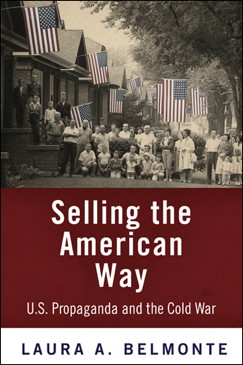
Selling the American Way: U.S. Propaganda and the Cold War by Laura A. Belmonte

Laura A. Belmonte is Associate Professor of History at Oklahoma State University.

UPEN Press - 2010
http://www.upenn.edu/pennpress/book/14433.html

In 1955, the United States Information Agency published a lavishly illustrated booklet called My America. Assembled ostensibly to document "the basic elements of a free dynamic society," the booklet emphasized cultural diversity, political freedom, and social mobility and made no mention of McCarthyism or the Cold War. Though hyperbolic, My America was, as Laura A. Belmonte shows, merely one of hundreds of pamphlets from this era written and distributed in an organized attempt to forge a collective defense of the "American way of life."
Selling the American Way examines the context, content, and reception of U.S. propaganda during the early Cold War. Determined to protect democratic capitalism and undercut communism, U.S. information experts defined the national interest not only in geopolitical, economic, and military terms. Through radio shows, films, and publications, they also propagated a carefully constructed cultural narrative of freedom, progress, and abundance as a means of protecting national security. Not simply a one-way look at propaganda as it is produced, the book is a subtle investigation of how U.S. propaganda was received abroad and at home and how criticism of it by Congress and successive presidential administrations contributed to its modification.

Introduction
Chapter 1: The Truman Years
Chapter 2: The Eisenhower Years
Chapter 3: Defining Democracy: Images of the American Political System
Chapter 4: Selling Capitalism: Images of the Economy, Labor, and Consumerism
Chapter 5: "The Red Target Is Your Home": Images of Gender and the Family
Chapter 6: "A Lynching Should Be Reported Without Comment": Images of Race Relations
Conclusion: The Costs and Limits of Selling "America"

The Cold War and the United States Information Agency: American Propaganda and Public Diplomacy, 1945-1989

Nicholas J. Cull, University of Southern California

Cambridge University Press, 2009
http://admin.cambridge.org/hu/academic/subjects/history/american-history-after-1945/cold-war-and-united-states-information-agency-american-propaganda-and-public-diplomacy-19451989#zwfQkmgdP7FXA5PC.97

Published at a time when the US government's public diplomacy has been in crisis, this book provides an exhaustive account of how it used to be done. The United States Information Agency was created, in 1953, to 'tell America's story to the world' and, by engaging with the world through international information, broadcasting, culture, and exchange programs, became an essential element of American foreign policy during the Cold War. Based on newly declassified archives and more than 100 interviews with veterans of public diplomacy, from the Truman administration to the fall of the Berlin Wall, Nicholas J. Cull relates both the achievements and the endemic flaws of American public diplomacy in this period. Major topics include the process by which the Truman and Eisenhower administrations built a massive overseas propaganda operation; the struggle of the Voice of America to base its output on journalistic truth; the challenge of presenting civil rights, the Vietnam War, and Watergate to the world; and the climactic confrontation with the Soviet Union in the 1980s. This study offers remarkable and new insights into the Cold War era.

Prologue: the foundations of US information overseas
1. Getting the sheep to speak: the Truman years, 1945–53
2. Mobilizing 'the P-Factor': Eisenhower and the birth of the USIA, 1953–6
3. In the shadow of Sputnik: the second Eisenhower administration, 1957–61
4. Inventing truth: the Kennedy administration, 1961–3
5. Maintaining confidence: the early Johnson years, 1963–5
6. 'My radio station': the Johnson administration, 1965–9
7. Surviving détente: the Nixon years, 1969–74
8. A new beginning: the Ford administration, 1974–7
9. From the 'two-way' mandate to the second Cold War: the Carter administration, 1977–81
10. 'Project Truth': the first Reagan administration, 1981–4
11. Showdown: the second Reagan administration, 1985–9
Epilogue: victory and the strange death of the USIA, 1989–99 Conclusion: trajectories, maps, and lessons from the past of US public diplomacy.

Empire of Ideas: The Origins of Public Diplomacy and the Transformation of U. S. Foreign Policy by Justin Hart

Oxford University Press, 2008
https://global.oup.com/academic/product/empire-of-ideas-9780199777945?cc=us&lang=en&# 

Examines how the FDR administration decided to promote America's image in the world to project the U.S. empire.    
Traces the emergence of "soft power" in US foreign policy to pre-World War II period, rather than the Cold War era.    
Addresses continuities between period covered and the full-scale propaganda war to combat negative perceptions of the United States in the Arab and/or Muslim world.    
Shows how communications technologies (newspapers, magazines, movies, radio, TV) were essential to public diplomacy.    
Contains fine-grained biographies of key figures, including Henry Luce, Archibald MacLeish, and others.

Covering the period from 1936 to 1953, Empire of Ideas reveals how and why image first became a component of foreign policy, prompting policymakers to embrace such techniques as propaganda, educational exchanges, cultural exhibits, overseas libraries, and domestic public relations. Drawing upon exhaustive research in official government records and the private papers of top officials in the Roosevelt and Truman administrations, including newly declassified material, Justin Hart takes the reader back to the dawn of what Time-Life publisher Henry Luce would famously call the "American century," when U.S. policymakers first began to think of the nation's image as a foreign policy issue. Beginning with the Buenos Aires Conference in 1936--which grew out of FDR's Good Neighbor Policy toward Latin America--Hart traces the dramatic growth of public diplomacy in the war years and beyond. The book describes how the State Department established the position of Assistant Secretary of State for Public and Cultural Affairs in 1944, with Archibald MacLeish--the Pulitzer Prize-winning poet and Librarian of Congress--the first to fill the post. Hart shows that the ideas of MacLeish became central to the evolution of public diplomacy, and his influence would be felt long after his tenure in government service ended. The book examines a wide variety of propaganda programs, including the Voice of America, and concludes with the creation of the United States Information Agency in 1953, bringing an end to the first phase of U. S. public diplomacy. Empire of Ideas remains highly relevant today, when U. S. officials have launched full-scale propaganda to combat negative perceptions in the Arab world and elsewhere. Hart's study illuminates the similar efforts of a previous generation of policymakers, explaining why our ability to shape our image is, in the end, quite limited.

Introduction: The Origins of U.S. Public Diplomacy
1. "Down with Imperialism": The Latin American Origins of U.S. Cultural Diplomacy
2. "The Drift of History": War, Culture, and Hegemony
3. Propaganda as Foreign Policy: The Office of War Information
4. "Foreign Relations, Domestic Affairs": The Consolidation of U.S. Public Diplomacy
5. "The Flat White Light": Revolutionary Nationalism in Asia and Beyond
6. "An Unfavorable Projection of American Unity": McCarthyism and Public Diplomacy
Epilogue The Creation of the USIA and the Fate of U.S. Public Diplomacy

Friday, June 8, 2018

Artificial Intelligence and International Relations - Graduate Class Shanghai University


Instructor: Tugrul Keskin              
Office:   College of Liberal Arts    
E-mail: mailto:tugrulk (at) vt.edu or Wechat: tugrulkeskin

If the government regulates against use of drones or stem cells or artificial intelligence, all that means is that the work and the research leave the borders of that country and go someplace else.
Peter Diamandis

I believe this artificial intelligence is going to be our partner. If we misuse it, it will be a risk. If we use it right, it can be our partner.
Masayoshi Son

Course Description and Objective

The focus of this course is Artificial Intelligence and International Relations. As a result of the modern economic system, a modern state was created with modern institutions, such as state bureaucracy, modern military, foreign ministries, intelligence services, police, etc. However, the modern economic system also produced modern private institutions, such as companies, think tanks, NGOs, international organizations, foundations, etc. Hence society and the individual have changed over time, becoming more educated, traveling more, working more, and becoming more selfish and more consumption oriented. On the other hand, in this process of transformation from traditional work to more automated dehumanized work, everything we do is recorded, watched, and observed by state or private institutions for security or consumption purposes. In the late 18th century, the invention of the steamship engine changed the basic dynamics of social and political structures; therefore, we started to see the new society based in the urban areas. The emergence of the modern state or nation-state was generated from this process of the new economy..............

American Top Secret Killer Terminator Robots for Future US Military Army (Full Documentary)


FULL SYLLABUS IS AVAILABLE UPON REQUEST..........

Tuesday, May 1, 2018

A New Journal: Global Review - The Institute of Global Studies - Shanghai University

https://mp.weixin.qq.com/s/dYtGnOVfk3C0mwhfya-HsQ
The "Global Review" is an academic journal sponsored by the Shanghai University Center for Global Studies. It aims to promote the development of a global academic discipline in China. It was founded in 2012, when the Shanghai University’s Global Studies Center is upgraded to the Institute of Global Issues, the Global Review will also be revised.
The new edition of the "Global Review" is dedicated to advancing global academic research and discipline development in the Chinese academic community, advocating cross-cultural, cross-regional and interdisciplinary approaches, focusing on global issues and global governance, and revealing the diversity of world civilizations and the road to modernization. Diversity.
Globalization is both a process and a more beneficial perspective. The two characteristics of “liquidity” and “networking” in the era of globalization have made it necessary for many issues to break the old paradigm of “nation-states” and place them in a global context. Scholars may have differences about the starting point of globalization, but no one questions the breadth and depth of the current globalization process. We sincerely hope that the “Global Review” can become a “survey field” in the Chinese academic community. Welcome Scholars at home and abroad are here to discuss and debate and contend for confrontation. Ultimately, they can agglomerate consensus and form a Chinese theory, school, and program on global studies.  

The Global Review has five sections:

(1) Global Theory

(2) Global issues and global governance

(3) Globalization and Regional Social Development

(4) Human Destiny Community

(5) Book reviews and academic information


The new edition of the "Global Review" will be published by the Social Sciences Academic Press and will be published twice a year. Anonymous peer review system was implemented, and the reply was given within two months of acceptance. The citation and annotation format of the manuscript is the same as "Chinese Social Sciences".
Please submit the manuscript to the editorial office of Global Review.

Mailing address: Building 3, East Campus, Baoshan Campus, Shanghai University, 333 Nanchen Road, Shanghai, China

Contribution email: globalstudies@126.com


《全球学评论》稿约
2018-05-02 上大全球问题研究院
《全球学评论》是由上海大学全球学研究中心主办的学术刊物,旨在推动国内全球学学科发展,2012年创刊。值上海大学全球学研究中心升级为全球问题研究院之际,《全球学评论》也将进行改版。
新版《全球学评论》致力于在中国学术界推进全球学的研究和学科发展,提倡跨文化、跨区域和跨学科的方法,聚焦全球议题和全球治理,揭示世界文明的多样性和现代化道路的多元性。
全球化既是一种进程,更是一种有益的视角。全球化时代的“流动性”和“网络化”这两个特征,使得许多议题必须要打破“民族国家”的陈旧范式,放置于全球语境中来考察。学者们对全球化的起始年代或许还存在分歧,但没有人质疑当下全球化进程的广度和深度,我们真诚地希望《全球学评论》能成为中文学术界里的一片“舆论场”,欢迎海内外学者在此切磋砥砺、争辩交锋,最终能凝聚共识,形成有关全球学的中国理论、学派和方案。
《全球学评论》设有五个版块:
(一)全球学理论
(二)全球议题与全球治理
(三)全球化与区域社会发展
(四)人类命运共同体
(五)书评与学术资讯
新版《全球学评论》将由社会科学文献出版社出版,每年2期。实行匿名审稿制度,2个月内给予录用与否的答复。稿件的引文和注释格式,同《中国社会科学》。
来稿请寄《全球学评论》编辑部
通信地址:上海市南陈路333号上海大学宝山校区东区3号楼(研究院大楼)上海大学全球问题研究院,200444
投稿邮箱:globalstudies@126.com